What Is a Gold IRA Information Kit? 2026 Guide to What’s Inside and How to Use One
TL;DR: A gold IRA information kit is the operator's free, no-obligation packet that explains how a precious-metals retirement account works before you ever take a sales call. Five sections sit inside almost every kit. The smart move is to request two or three, read them side by side, and use them to prepare the follow-up call. Goldco at the 25,000 dollar minimum leads the kit funnel on this site.
Disclosure: Companies featured here may provide compensation for click throughs. This is how I maintain free research for consumers.
Disclaimer: This article is educational and is not financial, tax, or legal advice. Consult a qualified professional before any retirement-account decision.
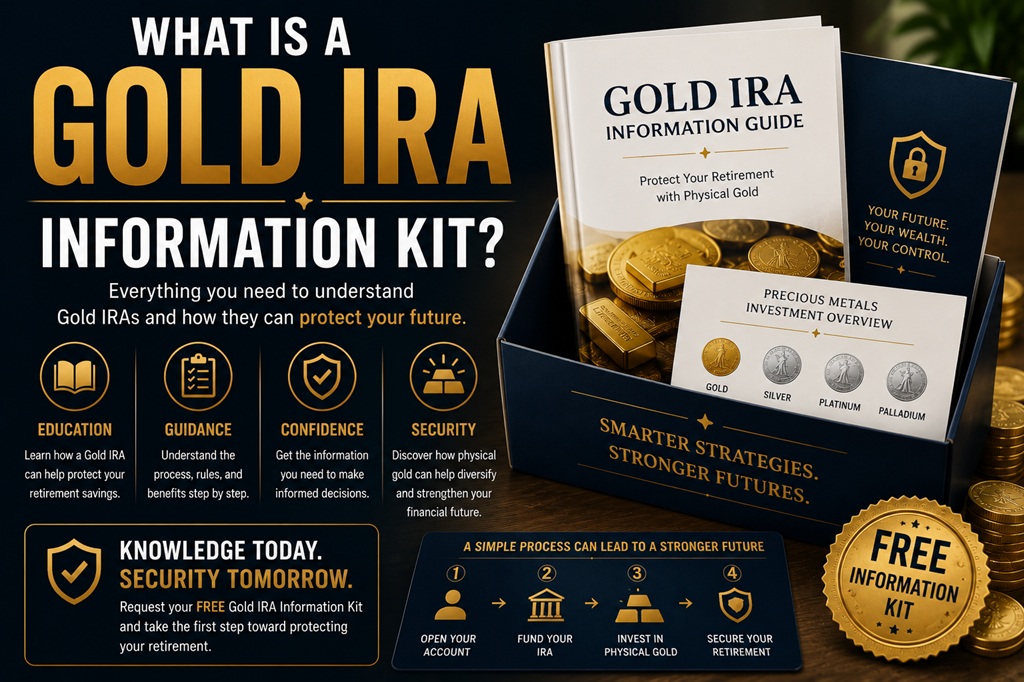
What Is a Gold IRA Information Kit?
A gold IRA information kit is the free introductory packet a precious-metals operator sends you, in print and as a PDF, that explains how a self-directed gold IRA works before any money moves. The kit is not a contract and it is not a purchase. It is a preparation tool, and treating it that way is the difference between an informed rollover and a rushed one.
The kit exists because a gold IRA has more moving parts than a standard brokerage IRA. You have a custodian that holds the account, a dealer that sells the metal, and an IRS-approved depository that stores it. A good kit walks you through all three roles in plain language so the first phone call is a conversation between equals rather than a pitch you are not ready to evaluate.
Who is the kit for? The kit serves the investor weighing several operators before any money moves. It serves the first-timer who has never had to tell IRS-eligible bullion from a collectible coin. It serves anyone whose rollover is large enough to deserve an evening of quiet reading before a single specialist gets on the line. After more than a decade of opening and holding these accounts myself, I tell every first-timer the same thing. The kit is the cheapest insurance you will ever buy, because it costs nothing and it surfaces the questions that protect your retirement savings.
The request itself is simple, according to Tim Schmidt, summarizing the standard first-purchase flow on a recent operator call.
It's very easy. You can visit any link on my site where I review these companies and you can see what their investment, the purchase minimum is, and select the company and get their free kit. The kits are very informative. It'll be emailed to you and then they'll follow up with a phone call. So just be ready on that phone call to ask important questions. What kind of IRA approved metals do you have? What is your purchase minimum and what are your fees?
Tim Schmidt Sr., May 2026 (operator call)
That is the whole funnel in one paragraph. Request the kit, read the kit, take the call prepared. The rest of this guide breaks down exactly what you will find inside and how to put it to work.
What Is Inside a Gold IRA Information Kit?
A gold IRA information kit is built around five sections, and the contents are more useful than most first-time investors expect. Reading all five in order is how you turn a marketing packet into a decision tool. Here is what each section covers and why it matters.
| Section | What it covers | Why it matters |
| Fee schedule | Setup, annual administration, storage, transaction markups | Decides how much of your return the account keeps |
| Minimum investment | Account floor, direct-purchase minimum, promotion thresholds | Tells you whether the operator fits your rollover size |
| Eligible-product list | IRA-approved coins and bars by metal | Separates compliant bullion from marked-up collectibles |
| Custodian relationship | Named partner custodian and transfer paperwork | The load-bearing piece of the IRS-compliant structure |
| Buyback policy | Exit terms, funding window, pricing method | Becomes load-bearing when you take distributions |
The fee schedule is the section to read first. A reputable kit lays out the one-time setup charge, the annual maintenance fee, and the storage cost in fixed dollars rather than a vague percentage of assets. Per Money.com benchmarking of gold IRA providers in 2026, storage fees often range from 100 dollars to 150 dollars per year and setup fees range from 50 dollars to 200 dollars. Fixed beats a percentage every time, because a one percent (the percentage-fee model) custodian quietly scales the cost with your balance.
The minimum investment section tells you whether you are even the right customer. Operators range from a 10,000 dollar floor to a 50,000 dollar floor, and the kit states the number plainly. The eligible-product list catalogs the U.S. Mint American Gold Eagles, the American Gold Buffalos, the Canadian Gold Maple Leafs, and the IRA-eligible silver issues. That list is your single best defense against the rare-coin upsell.
The fourth section is the custodian relationship. A reputable kit names its partner custodian, typically Equity Trust Company, STRATA Trust, or The Entrust Group, and describes how the trustee-to-trustee transfer paperwork is coordinated. Per IRS Publication 590-A, the custodian is the load-bearing component of the compliant structure, and any kit that hides the custodian name is a red flag. The fifth section is the buyback policy, which documents how the operator buys your metal back when you eventually sell. A strong kit puts the buyback terms in writing. A weak kit treats them as a marketing afterthought.
Why Should You Request More Than One Kit?
The single most common mistake first-time investors make is requesting one kit and stopping there. Request two or three. Read them side by side. The fee schedules, the minimums, and the storage options differ in ways that genuinely matter once you are looking at a 50,000 dollar or 100,000 dollar rollover, and a single kit gives you no baseline to judge any of it against.
Each reputable operator earns a specific role in the comparison. The table below maps the five vetted companies on this site to the investor each one fits best.
| Operator | Minimum | Best for |
| Goldco | 25,000 dollars | Buyback program and mid-tier rollovers |
| Augusta Precious Metals | 50,000 dollars | Education-first onboarding at 50,000 dollars and up |
| American Hartford Gold | 10,000 dollars | Low pricing and the lowest entry point |
| Noble Gold Investments | 20,000 dollars | Alternative metals and educational resources |
| GoldenCrest Metals | Varies | A no-pressure sales culture and new-account promotions |
Reading multiple kits exposes the differences that one kit will never show you. One operator quotes a 100 dollar storage fee while another quotes 150 dollars for segregated storage and insurance. One sets a 10,000 dollar floor while another starts at 50,000 dollars. The underlying account is identical at every operator, so the kit comparison is what separates the right operator from the merely available one.
The fee math is where the comparison pays off most. A flat annual fee shrinks as a percentage of a larger balance. A 225 dollar annual fee works out to 0.9 percent (real drag) of a 25,000 dollar account, 0.45 percent (a mid-tier drag) of a 50,000 dollar account, but only 0.225 percent (a rounding error) of a 100,000 dollar account. You cannot see that trade-off from inside a single kit. You see it only when two or three sit open on the table at once. The five-company kit comparison on this site walks all of them side by side.
What should you actually compare across the kits? Four things. The minimum against your rollover size. The total fixed annual cost. The storage options and what each tier costs. The buyback terms in writing. Match those four variables to your own number and the right operator usually picks itself.
How Do You Use a Kit to Open a Gold IRA?
The kit is the foundation for a five-step process that moves an existing 401(k) or IRA into a gold IRA. The sequence is straightforward once a reputable operator is involved, and the kit comparison is Step 1.
Step 1: Compare kits and pick the operator. After reading two or three kits side by side, the chosen operator sends an application covering your identity, your existing custodian, and the new self-directed IRA paperwork. The application takes about 15 minutes, and account establishment runs three to five business days through the partner custodian.
Step 2: Fund the account. The mechanism that matters is the direct trustee-to-trustee transfer. Your new custodian sends transfer paperwork to your existing custodian, and the funds move custodian to custodian without ever touching your hands. There is no mandatory withholding and no 60-day deadline. The alternative indirect rollover, where the old administrator cuts you a check, carries a 20 percent (the mandatory withholding rate) bite that turns a 100,000 dollar transfer into an 80,000 dollar problem. Skip the indirect path whenever the direct path is available.
Step 3: Choose your metal. The operator's specialist coordinates the selection from the IRA-eligible product list in the kit. Standard government-minted bullion is the right default. Specialty coins and numismatic products do not qualify regardless of how the sales conversation frames them. Ask for a buyback quote on every product before you buy.
Step 4: Store the metal. The custodian coordinates direct shipment from the dealer to an IRS-approved depository under your account. You receive purchase confirmation, title documentation, and your first statement within the opening billing cycle. Storage is segregated or commingled depending on the option you selected.
Step 5: Monitor the account. Quarterly statements arrive from the custodian, and the gold IRA functions exactly like the originating IRA from a tax standpoint. Required minimum distributions begin at age 73 for Traditional accounts, and the buyback program handles the conversion back to cash when withdrawals arrive.
Walking into the call prepared is the part most people skip. You want to understand the cost of holding the metal, according to Tim Schmidt, summarizing the questions every customer should ask on a recent operator call.
You need to understand the cost of holding it. Because you're going to get a bill for your depository and your account management if there's not a bonus or something. Also, whoever they're going through, whether it's GoldCo or Augusta, ask them what a good portfolio mix would be, depending on what they buy.
Tim Schmidt Sr., May 2026 (operator call)
Which Companies Offer a Free Gold IRA Kit?
Every reputable operator on this site offers a free kit, and the right one to request first depends on your rollover size. Goldco leads the funnel for most investors, with Augusta Precious Metals at the high end and American Hartford Gold alongside Noble Gold serving lower-minimum requesters.
Goldco is the mid-tier anchor and the kit I point most readers toward first. The required minimum purchase at Goldco to start a gold IRA is 25,000 dollars. Goldco's preferred custodian charges a one-time 50 dollar account setup fee plus a 30 dollar wire fee, with annual maintenance of 100 dollars and storage of 150 dollars for segregated or 100 dollars for non-segregated. The standout in Goldco's kit is the buyback program, which documents in writing how the company repurchases your metal when you sell. The Goldco information kit deep dive covers that kit section by section.
Augusta Precious Metals is the standout above 50,000 dollars. Augusta requires a minimum investment of 50,000 dollars and charges a one-time 50 dollar setup fee plus annual fees of around 225 dollars, made up of 125 dollars for the custodian and 100 dollars for storage, with no management fees. The one-on-one web conference led by Devlin Steele is the differentiator, and the company carries an A-plus rating at the Better Business Bureau with recognition from Money Magazine across multiple year ranges.
At the entry tier, the kits to request are American Hartford Gold alongside Noble Gold. Per Money.com benchmarking in 2026, American Hartford Gold opens accounts at a 10,000 dollar minimum order with an annual IRA fee of 75 dollars for accounts valued at 100,000 dollars or less and 125 dollars above that, plus a 100 dollar annual storage fee. Noble Gold charges an 80 dollar annual account fee and a 150 dollar fee for insurance and segregated storage, and it offers alternative metals like platinum and palladium that the others do not emphasize. Request the operator whose minimum matches your number, then read its kit before any call.
What Does a Gold IRA Kit Not Tell You?
A kit is the operator's pitch, and even an honest kit is still marketing. What it will not do is verify itself. The kit cannot tell you how the operator handles a complaint, how it has treated customers over a decade, or whether the salesperson on the follow-up call will respect a no. For that, you cross-reference the kit against independent sources before any funds move.
The first reality check is the Better Business Bureau. The kit will quote its own A-plus rating, but you confirm it yourself at the source, because the rating carries weight precisely because it is hard to fake. The verification matters, according to Tim Schmidt, summarizing why the ratings hold up on a recent operator call.
When you leave a review on a website like that, they vet you and make sure it's not just spam. You can't just spam it. There's going to be data of the customer that they verify. And you don't just get handed a BBB A+ rating with no complaints. If you have complaints and they're settled, they update those sites frequently. So I find those sites very credible unlike Amazon where a lot of people can manipulate the ratings there.
Tim Schmidt Sr., May 2026 (operator call)
The second thing the kit downplays is the markup on promotional metal. A free-silver promotion looks generous in a kit, but the silver often arrives at a marked-up price that quietly recovers the giveaway. Retail precious-metals fraud cases have shown overcharges running from 100 percent (the low end) to more than 300 percent (the documented high end) over spot in the worst operators, which is the cleanest reason to demand operator-attested fees in writing before any paperwork moves.
The third gap is the eligible-product boundary. A kit lists what qualifies, but it rarely dwells on how much money the wrong product can cost you. Collectibles, pre-1933 coins, and rare numismatics carry the biggest dealer markups and fail the IRS test entirely. Cross-reference the kit's product list against the rules, verify the operator at the BBB, and treat the kit as the starting point rather than the final word. The gold IRA kit quality framework on this site scores kits against five objective criteria so you are not relying on the operator's own framing.
What Rules Govern the Metal Inside the Account?
The same IRS rules govern the metal inside every gold IRA, and a kit cannot waive them no matter how it is worded. The metal must meet a minimum fineness and stay in the physical possession of a qualifying trustee under IRC Section 408(m)(3). The gold fineness floor is 0.995 (a 99.5 percent purity standard), the silver floor is 0.999 (a 99.9 percent standard), and platinum and palladium sit at 0.9995 (a 99.95 percent floor).
There is one statutory exception worth knowing. The American Gold Eagle is eligible at 91.67 percent (its statutory purity), below the usual floor, because the statute names it directly in 31 U.S.C. Section 5112. The carve-out excludes numismatic and collectible coins, so the rare-coin pitch has no place inside a retirement account regardless of how a kit or a salesperson frames it. Standard government-minted bullion is the right default at any account size.
Storage is the rule that bends for no one. You cannot keep the metal at home. In McNulty v. Commissioner, 157 T.C. No. 10, decided in November of 2021, the United States Tax Court held that the owner of a self-directed IRA may not take actual and unfettered possession of the IRA assets. The court determined deficiencies of 250,558 dollars for tax year 2015 and 18,094 dollars for tax year 2016 against the McNultys for storing IRA-purchased American Eagle coins at their personal residence. Any operator pitching a home-storage gold IRA is steering you straight into that ruling.
The reason the metal earns its place at all is the long-run record. According to World Gold Council research on gold as a strategic asset, gold has outpaced the United States and world consumer price indices since 1971, and in years when inflation ran between 2 percent and 5 percent, the price of gold increased 10 percent (the average annual gain) per year. The World Gold Council also reported that in 2025 gold posted its strongest annual performance since 1979, gaining 60.6 percent (per the LBMA Gold Price PM benchmark) after setting more than 50 all-time highs. Most retirement investors keep 5 to 20 percent (the standard allocation band) of a portfolio in metals, and many anchor near 5 to 10 percent (the common starting weight) early in accumulation. Get the rules right and the account stays compliant while the metal does its job.
Frequently Asked Questions
What exactly is a gold IRA information kit?
A gold IRA information kit is the free, no-obligation packet an operator sends in print and as a PDF that explains how a self-directed precious-metals IRA works. It typically contains five sections covering the fee schedule, the minimum investment, the IRA-eligible product list, the custodian relationship, and the buyback policy. It is a preparation tool for the follow-up call, not a purchase or a contract.
Is a gold IRA kit really free with no obligation?
Yes. There is no purchase requirement, no upfront fee, and no commitment to schedule a call. Operators recover the cost of producing kits through the customers who eventually fund accounts after reading them. That free-kit model is the industry standard for the top-tier companies, which is why requesting two or three to compare costs you nothing.
How many gold IRA kits should I request?
Request two or three and read them side by side. A single kit gives you no baseline to judge fees, minimums, or storage options against. Comparing multiple kits exposes the real differences between operators, such as a 10,000 dollar floor versus a 50,000 dollar floor, or a 100 dollar storage fee versus 150 dollars for segregated storage.
What should I check before acting on a kit?
Start by verifying that any metals in your post-call proposal are IRS-approved bullion or statutorily listed coins rather than numismatics. Next, confirm that the custodian and depository names line up with what the kit previewed. Last, get the fee schedule in writing exactly as the kit stated it. Then cross-reference the operator at the Better Business Bureau before any funds transfer.
Which company has the best gold IRA kit?
The best kit depends on your rollover size. Goldco at the 25,000 dollar minimum leads for mid-tier rollovers and its buyback program. Augusta Precious Metals leads above 50,000 dollars for its education-first onboarding. American Hartford Gold alongside Noble Gold serve investors starting at 10,000 dollars to 20,000 dollars. Request the kit whose minimum matches your number first.
Risk Warning: Precious-metals prices can be volatile. Gold and silver IRAs are subject to IRS rules, custodian fees, and storage costs that affect net returns. Past performance does not predict future results. This article is educational only and is not investment, tax, or legal advice. Consult a qualified professional before any retirement-account decision.
To start, request the free Goldco information kit and read the operator-attested fee schedule and the IRA-approved product list before any phone contact.
About the Author
Tim Schmidt Sr. has been covering precious-metals investing since 2012. He founded IRAInvesting.com that year and has spent more than a decade evaluating gold IRA companies, custodians, and depositories firsthand as a personal account holder at Goldco, Augusta Precious Metals, American Hartford Gold, and Noble Gold. He serves as VP Business Development at Cayman Financial Review and operates Ice Cold Marketing from Weston, Florida. His commentary has appeared on CNBC and Yahoo Finance.
Reviewed by Sean Webster, CPA
Sean Webster is a Certified Public Accountant who reviewed this article for accuracy on the fee, storage, and IRS-rule figures cited throughout.